We use essential storage to run the site. With your permission, we use Google Analytics to understand site use and improve our services. We do not use analytics to collect the details you enter in calculators or forms.
Privacy Policy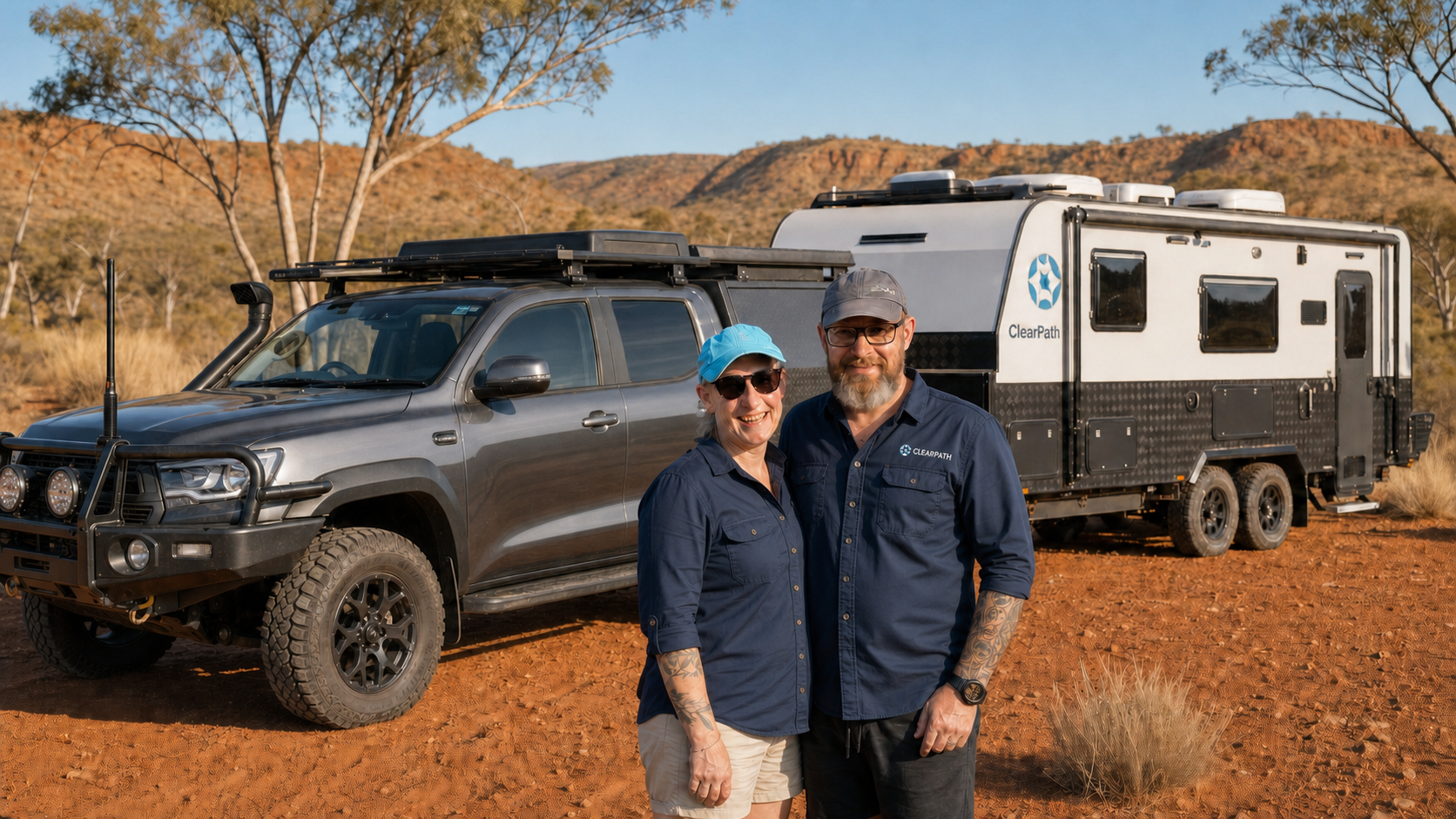
About ClearPath
ClearPath was founded by Ian and Sandy Blewitt.
Practical experience in mechanical work, heavy-combination vehicles and vehicle modification highlighted a recurring problem: owners often make expensive purchase and setup decisions without a complete view of payload, axle and towing constraints.
Too often, people relied on opinions from social media, sales advice, or guesswork instead of objective information.
ClearPath was created to change that.
Our mission is simple: provide everyday caravan and towing enthusiasts with clear, independent, easy-to-understand reports that help them make informed decisions before they buy, modify or tow.
Unlike traditional consultancy businesses, ClearPath has been built as an automated digital advisory platform. Customers complete a guided questionnaire online and receive a professionally prepared report based on the information provided, using supplied figures and available reference data. No state-specific modification approval assessment is included.
Everything we do is driven by three core values:
- Safety before convenience.
- Facts before opinions.
- Education before sales.
ClearPath is completely independent. We do not sell vehicles, caravans, towbars or accessories, and we are not paid commissions to recommend particular products. Our only objective is to provide information that helps Australians make safer and more informed towing decisions.
The platform represents thousands of hours of research, development, testing and refinement. Every part of the customer journey—from online ordering through to automated report generation—has been designed to deliver practical advice quickly, consistently and at an affordable price.
Whether you're buying your first caravan, modifying your tow vehicle or organising the measurements and documents for your setup, ClearPath is here to help you make informed decisions.
Before you buy. Before you modify. Know the risks.
Legal Entity
How Reports Are Generated
ClearPath reports are generated through a four-step process that combines deterministic calculations, stored reference data and AI-assisted explanation. Numerical report sections are controlled by server calculations; missing measurements remain unknown.
1. Deterministic Calculations
Core weight calculations — payload, GVM, GCM, axle load distribution and tow ball mass — use arithmetic and static load models; applicability and exact vehicle ratings require separate verification. These calculations produce the same result for the same input every time. AI text is restricted to qualitative explanation.
2. Stored Manufacturer & Reference Data
Vehicle specifications, caravan specifications and accessory weights are stored in our database from manufacturer-published compliance plate data, specification sheets and dealer documentation. Each record carries a confidence rating (high, medium, low) based on its source.
3. AI-Assisted Explanation
AI is used to interpret the calculation results and explain what they mean for your specific setup — identifying risks, suggesting improvements and writing the advisory narrative in plain Australian English. The AI does not generate the underlying weight figures; those come from deterministic calculations and stored data.
4. Advisory Output, Not Certification
ClearPath is not a certified engineer, not a legal advisor, and not a compliance authority. Our reports provide independent analysis and risk identification to support your decision-making.
What AI Does
- Interprets calculation results for your specific setup
- Identifies potential risks and overload conditions
- Suggests improvements and alternative configurations
- Writes the advisory narrative in plain Australian English
- References relevant standards and specifications
What AI Does Not
- Generate or modify the underlying weight calculations
- Certify vehicles or provide engineering compliance
- Replace manufacturer compliance plate data
- Replace actual measurements from a suitable weighbridge or competent mobile weighing service
Measurements make your assessment more useful
Manufacturer plates and specifications establish limits. Measurements establish what your setup actually weighs. A suitable weighbridge or competent mobile weighing service can provide measured weights using appropriate equipment. Ask the provider what equipment and calibration evidence supports the measurements.
Keep a dated record of the loading condition: occupants, fuel, water, accessories and luggage. For a towing combination, ask which vehicle axle, trailer axle and towball weights were measured, whether the vehicle was coupled or uncoupled, and which figures were calculated. Missing measurements remain unknown; an advisory report does not certify the setup.
Practical Industry Experience
ClearPath combines real-world experience with deterministic calculations, available manufacturer and reference data, and AI-assisted reporting. This experience contributes practical understanding of vehicle loading, towing configurations, steering, suspension, handling, accessories and modifications.
Ian
A licensed mechanic with practical mechanical and heavy-combination vehicle operating experience.
Sandra
Vehicle-repair industry experience with current involvement in steering and suspension business operations.
Sources & Review Method
ClearPath uses only verifiable source categories. We do not fabricate citations, qualifications, partnerships or testimonials.
Manufacturer Documentation
Compliance plates, specification sheets and official product pages from vehicle and accessory manufacturers. These carry the highest confidence rating.
Australian Road Authority Guidance
National and state-level standards including Australian Design Rules (ADR) for vehicle mass limits, axle load ratings and towing combination weights.
User-Entered Data
Vehicle specifications, accessory weights and towing configuration details entered by you during the intake process. These are used as-is and clearly labelled as customer-supplied in the report.
Data Confidence Ratings
Every vehicle and caravan specification in our database carries a confidence rating based on its source.
High
Manufacturer-published compliance plate or specification sheet
Medium
Dealer documentation or specification from a publication
Low
Estimated or customer-supplied data requiring verification
Content Review
ClearPath's advisory guides and calculation methodology are reviewed for accuracy against Australian standards and manufacturer data. A named content reviewer field is reserved for future publication once a qualified reviewer is appointed. Until then, all content is labelled with its last-updated date and source confidence rating.
How Articles & Database Records Are Selected
Educational articles are written to explain Australian towing concepts in plain English. Articles are organised into topic areas (Towing Basics, Understanding Weights, Safe Loading & Setup, and others) so readers can find relevant guidance quickly.
Where an article is still being researched or drafted, it is labelled “guide in development” rather than published with incomplete or unverified information. We do not publish content we cannot substantiate.
Database records — vehicle specifications and caravan specifications — are compiled from Australian-market manufacturer publications and authoritative reference material. Each record carries a confidence rating (high, medium, low) and a verification status (verified or unverified) based on its source. Records are not marked as verified until they have been checked against the source.
Missing fields are shown as absent — never as zero, “N/A” presented as a value, or fabricated. If a specification is not available, the field simply does not appear on the detail page.
Three Types of Data on This Site
It is important to understand the difference between these three types of information.
Manufacturer-Published Data
Specifications from compliance plates, official specification sheets and manufacturer publications. On detail pages, these are labelled with a blue “Manufacturer Specifications” badge. These figures reflect what the manufacturer states — they are not ClearPath’s own measurements.
Sourced Reference Data
Specifications compiled from dealer documentation, automotive publications and other reference sources. Each record carries a confidence rating based on the source quality. These are not ClearPath measurements — they are compiled from available reference material and may not reflect every variant or build.
ClearPath Educational Observations
General educational guidance written by ClearPath to help you understand what the numbers mean — for example, how towball download affects payload, or why GCM limits the combined weight. On detail pages, these are labelled with a purple “ClearPath Educational Observations” badge. These are interpretive guidance, not specifications.
Why You Must Verify Figures
Specifications change. Manufacturer specifications can change between model years, option packs and build dates. A database record may reflect a different build to your specific vehicle or caravan.
The compliance plate is the legal source. The compliance plate on your specific vehicle or caravan is the legally binding source of figures. Always check it — do not rely on a database record alone.
Actual loaded weights require appropriate measurement. ClearPath database records show manufacturer-stated maximums, not your actual loaded weight. Accessories, passengers, cargo, water and fuel all add weight. Use an appropriate weighbridge or calibrated axle/wheel scales with competent measurement of the fully loaded setup. Manufacturer plates and documents establish permitted limits; scales establish actual loads.
Cross-reference current manufacturer material. Always confirm critical figures against the current manufacturer documentation for your specific variant and build year before making purchasing, modification or towing decisions.
Data Currency & Verification
ClearPath does not fabricate review dates, verification dates or source citations. Where a record has been reviewed, the “last reviewed” date is shown on the record’s detail page. Where no review date exists, no date is shown — do not assume the data is current.
Each database record displays its source, confidence rating and verification status where available. Check these fields on the detail page for the most accurate assessment of data currency for that specific record.
Specifications can change between model years and build dates. Always cross-reference with current manufacturer material and your vehicle’s compliance plate before relying on any figure.
If a record shows “unverified” or a low confidence rating, treat the figures as preliminary and confirm them independently before use.
Corrections & Updates
If you find an error in a ClearPath article or database record, please let us know. Include the page URL, the specific figure or statement in question, and the source you believe is correct. We review and update verified errors promptly — we do not publish corrections without verifying the source.