We use essential storage to run the site. With your permission, we use Google Analytics to understand site use and improve our services. We do not use analytics to collect the details you enter in calculators or forms.
Privacy PolicyIllustrative Dual-Cab Build With Front-Axle Pressure
A common Australian touring build — bull bar, winch, canopy, drawers — that looked fine on paper until the axle weights were considered separately.
This scenario is a composite educational example. Vehicle type, weights and figures are representative, not from a specific vehicle.
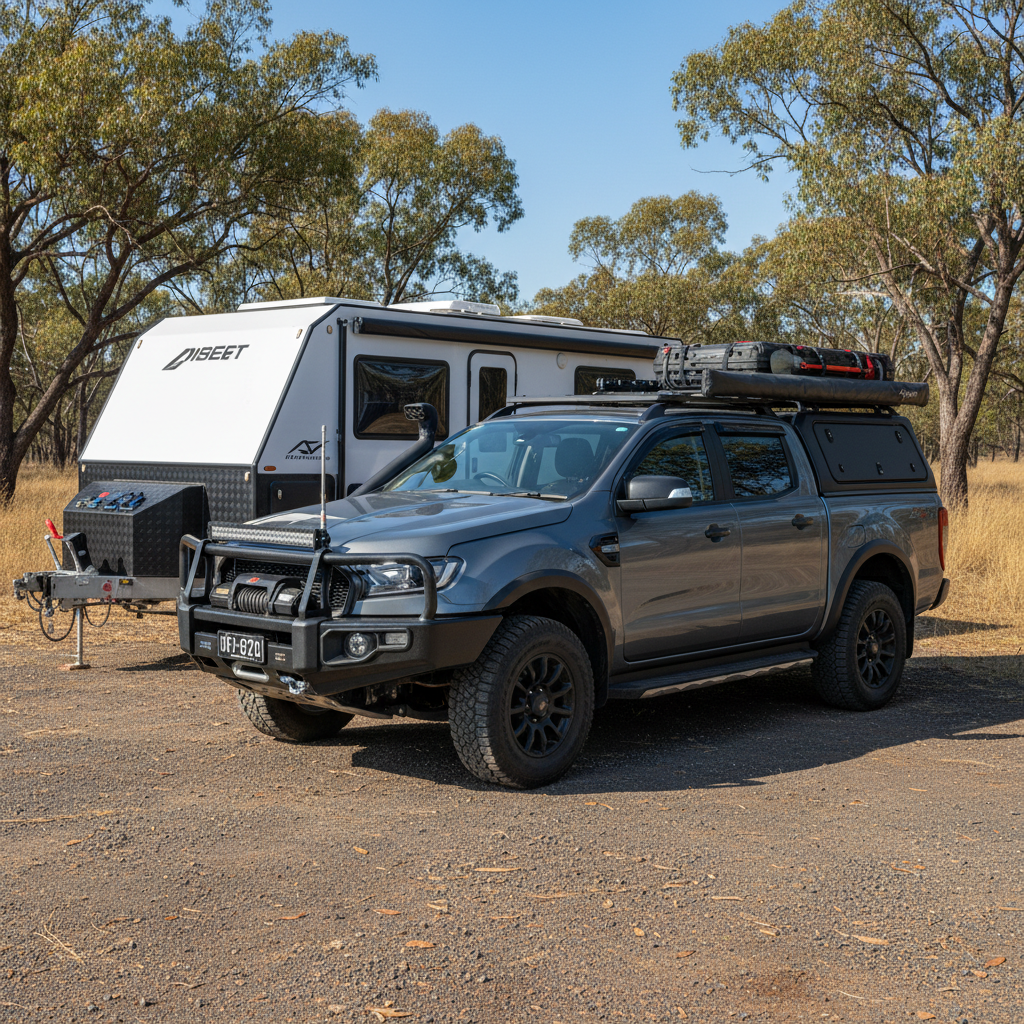
Generated illustration of a representative touring setup. It is not a photograph of a customer vehicle or weighbridge assessment.
Vehicle Setup
This composite scenario models a late-model dual-cab utility — a popular platform for Australian touring. The accessory list represents a build accumulated progressively over time; it is not a verified customer vehicle or installation record.
Vehicle Ratings
- GVM (Gross Vehicle Mass)3200 kg
- Tare Weight (unloaded)2180 kg
- Payload Allowance1020 kg
- Front Axle Rating1450 kg
- Rear Axle Rating1700 kg
Towing Setup
- Standard tow bar and wiring loom
- Weight distribution hitch capable
- Intended to tow a 2,800kg ATM caravan
- Tow ball mass estimated at 230–270kg
Accessories Fitted & Estimated Weights
What Went Wrong
Front Axle Overload Risk Identified
The vehicle was within its overall GVM — but when the front and rear axle loads were estimated separately, the front axle was carrying approximately 1096kg against a rated limit of 1450kg. That is an estimated -354kg over the front axle rating.
Note: These are estimated loads for educational purposes. Actual axle loads require weighbridge measurement and are affected by load position, fuel level, passengers and terrain.
Why It Happens
This situation is very common and is not anyone's fault specifically. It happens for a few straightforward reasons.
Accessories are added one at a time
Each individual accessory seems manageable on its own. A bull bar and winch fitted in year one, a canopy in year two, drawers a few months later. No single purchase feels like a weight problem — but the total adds up quickly.
GVM is not the only number that matters
Most people know about GVM — the vehicle's total weight limit. Far fewer people know that each axle also has its own separate load rating. A vehicle can be within GVM but still have an overloaded front or rear axle.
Front-heavy accessories are common in touring builds
Bull bars, winches, and driving lights are practical and popular. They are also almost entirely mounted ahead of or over the front axle. That load accumulates at the front end — and front axle ratings are often lower than rear axle ratings.
Nobody checks axle ratings at point of sale
Accessory suppliers and installers are not typically required to check or advise on your axle loads. Each business sells and fits its own product. No single party in the chain has responsibility for reviewing the whole picture.
How Weight Distribution Affects Compliance
Compliance is not just about whether the total weight is under the GVM. Regulators, insurers and engineers look at how that weight is distributed — specifically across each axle.
Simplified Load Distribution Illustration
Illustration only. Actual axle loads depend on load position, terrain, and towing conditions.
Steering & Control
An overloaded front axle puts extra stress on steering components. Under braking, an overloaded front end can increase stopping distance and reduce driver control.
Tyre & Suspension Wear
Operating beyond axle ratings accelerates tyre and suspension wear. This is not always visible in the short term — but the damage compounds over time.
Insurance & Legal Risk
In the event of an accident, insurers and investigators may examine whether the vehicle was within its legal weight ratings. An overloaded axle can affect a claim.
Towing adds another layer. When towing a caravan, the tow ball mass pushes down on the rear of the vehicle. This can actually reduce front axle load — but it introduces rear axle and GCM considerations. The full picture changes significantly when a van is attached.
Possible Solutions
There is no single right answer — the best solution depends on your specific vehicle, how it is used, and what you are willing to change. These options represent a range of approaches from simple to significant.
Reduce Front-End Weight
PracticalA lighter alloy or plastic-composite bull bar can save 15–25kg compared to a full steel unit. Some winch-compatible designs retain strength while cutting weight significantly.
Relocate the Winch
PracticalA mid-mount or rear-mounted winch removes the heaviest single front accessory from the nose of the vehicle. This is a significant change but highly effective for front axle relief.
Review What Lives on the Roof
PracticalItems stored on a roof platform raise the centre of gravity and often end up over the front axle depending on placement. Moving heavy items lower and further rearward helps redistribute load.
GVM Upgrade Assessment
Needs EngineerIf overall GVM is the binding constraint, investigate whether an eligible approval pathway exists for the exact vehicle and jurisdiction.
Load Management Review
PracticalAdjusting what is packed where — keeping heavy camp gear over the rear axle, water in rear-mounted tanks, fuel cans low and rearward — can redistribute weight without any hardware changes.
Lessons Learned
This scenario plays out regularly across Australia. Here are the key takeaways that apply to most touring builds.
Accessories are almost never sold with a weight compliance review included.
Front axle load limits are often reached before the overall GVM limit.
Adding items one at a time over months or years can hide the cumulative weight impact.
Even vehicles within GVM can exceed individual axle ratings — both numbers matter.
A weighbridge only gives total weight — axle-by-axle assessment requires specific weighing.
Lighter alternatives exist for most accessories and are worth comparing before purchase.
The Bottom Line
A vehicle that is within its GVM is not necessarily compliant. Axle ratings are separate limits and are just as legally relevant. If your vehicle has significant front-end accessories — particularly a bull bar and winch — it is worth getting the axle loads assessed, not just the total weight.
Does This Sound Like Your Setup?
If your vehicle has a bull bar, winch, and significant rear accessories, an axle load assessment is a sensible step before your next trip.
View all case studies