How to read weight figures and examples
- Ratings are maximum limits, not measurements of your loaded setup. Confirm the exact variant and approved ratings.
- Measure loaded coupling weight. A percentage or the difference between ATM and GTM ratings does not establish today's coupling weight.
- An added load changes both axle reactions according to its position. A change is not a total axle load; use measured starting axle weights and add each load once.
- Combination mass is unhitched loaded vehicle plus total loaded trailer, or the sum of all coupled axle readings. Count coupling mass once.
- Examples and AI suggestions are planning aids, not verified measurements or compliance clearance. Unknown figures require measurement; active weight-distribution hitches and gooseneck arrangements need their own assessment.
Introduction
A GVM upgrade — Gross Vehicle Mass upgrade — is one of the most discussed modifications in the Australian touring and towing community. The appeal is straightforward: if your vehicle is close to or over its GVM with your planned setup, an upgrade raises the limit and restores legal headroom.
But GVM upgrades are frequently misunderstood. Most standard upgrades do one specific thing: they increase the vehicle's gross mass rating. However, some approved upgrade packages go further — and understanding exactly what your specific upgrade includes or excludes is critical before assuming what has — or hasn't — changed.
This article explains what a GVM upgrade actually is, how it works, and when it will and won't address your setup's weight issues.
---
What a GVM Upgrade Actually Is
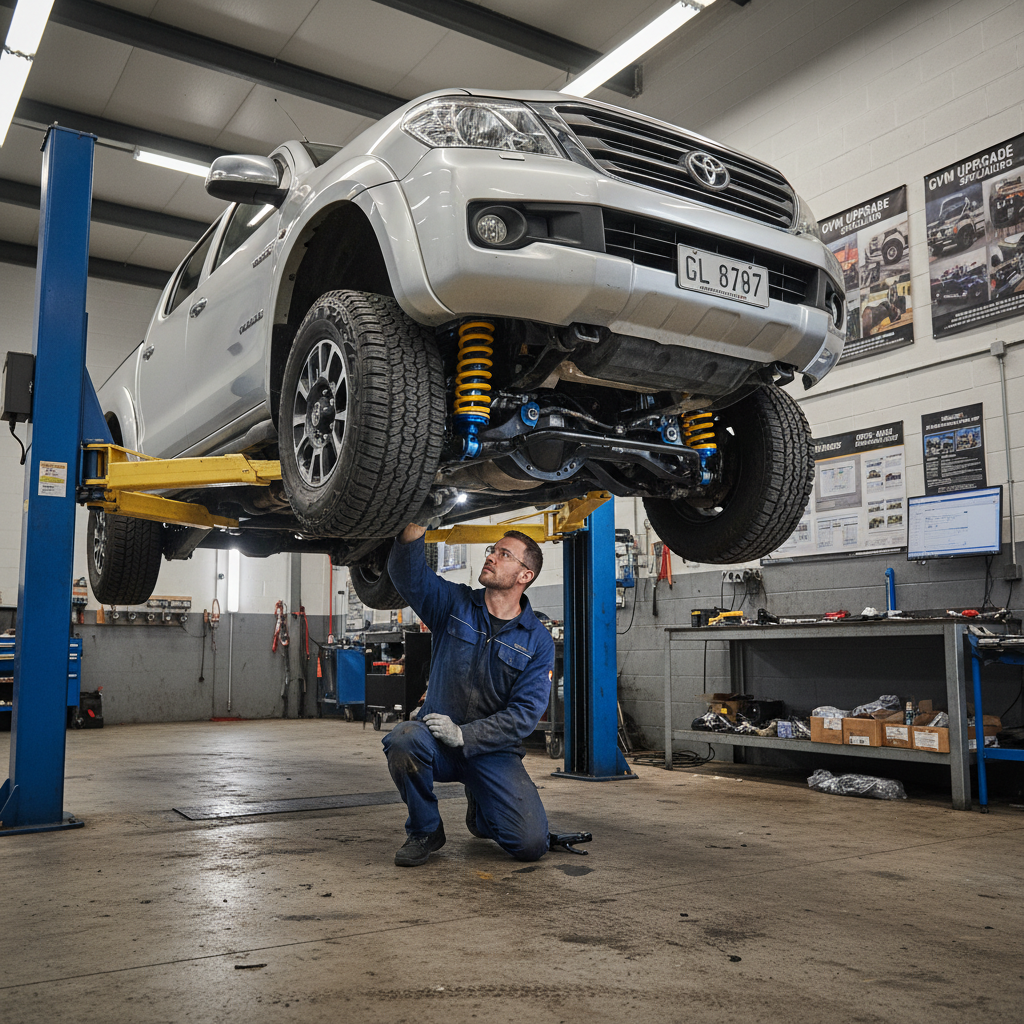
A GVM upgrade is a formal engineering modification that increases the maximum legal weight your vehicle can carry. In practical terms, it raises the GVM figure on your vehicle's compliance paperwork, typically by 200–500kg depending on the vehicle platform and upgrade kit.
The upgrade usually involves:
The result is a vehicle that can legally operate at a higher gross weight — meaning its GVM is now, say, 3,700kg instead of 3,200kg. The payload increases by the same amount.
---
What a GVM Upgrade Does
**Increases GVM:** The GVM figure on the compliance plate and associated paperwork increases to the new, upgraded level.
**Increases payload:** Because payload = GVM − Tare weight, and tare weight doesn't change, more GVM directly means more available payload.
**May improve suspension load capacity:** The upgraded suspension components installed as part of the kit are designed to handle the higher load.
**Provides engineering documentation:** A properly completed GVM upgrade includes engineering certification relevant for insurance purposes, roadworthiness, and state registration requirements.
---
What a Standard GVM Upgrade Typically Does NOT Do
**Increase axle ratings:** Many GVM upgrades increase the vehicle's gross mass without changing the manufacturer's front or rear axle ratings. However, some approved upgrade packages — particularly those involving engineering-certified axle or suspension system changes — may also increase axle ratings. Always refer to the specific approval documentation for your upgrade to confirm what has and has not changed.
**Increase GCM:** Many GVM upgrades do not change Gross Combination Mass — the combined weight of vehicle and trailer. However, some approved upgrade packages may include a GCM increase where specifically authorised by the upgrade provider and applicable approval process. If GCM is your binding constraint, check your specific upgrade documentation. If GCM is not included in the upgrade, it remains unchanged.
**Change the tow ball download limit:** The vehicle's rated tow ball download limit is typically set by the tow bar and vehicle manufacturer. Some upgrade packages may address this — but most do not. Verify against your specific upgrade certificate.
**Change the tow rating:** Maximum tow rating is determined by the vehicle's drivetrain, braking system, and chassis. Many GVM upgrades do not alter this. Some approved packages may increase braked towing capacity where specifically authorised — but this is not the norm. Verify against your upgrade approval documentation.
**Retroactively fix an overloaded axle:** If rear axle overload is caused by a heavy canopy, long-range tank, and tow ball mass, a standard GVM upgrade kit typically does not resolve this. Some upgrade packages include axle rating changes — but not all. Confirm with your upgrade provider.
> **Important:** Many GVM upgrades increase Gross Vehicle Mass without changing manufacturer axle ratings. However, some approved upgrade packages may also increase axle ratings, Gross Combination Mass (GCM) or towing capacity where specifically authorised by the upgrade provider and applicable approval process. Vehicle owners should always refer to the approval documentation associated with their specific vehicle and upgrade.
---
When a GVM Upgrade Solves the Problem
A GVM upgrade is genuinely useful when:
**GVM is the binding constraint.** Your vehicle is close to or over GVM, but axle ratings, GCM and tow ball download are all within limits. The upgrade adds the payload headroom you need.
**Your setup loads the vehicle relatively evenly.** When the total load is near GVM but no individual axle is significantly overloaded, the GVM upgrade addresses the actual constraint.
**The upgrade is combined with appropriate suspension components.** The suspension upgrade means the vehicle is actually rated and equipped to handle the higher load.
---
When a GVM Upgrade Won't Solve the Problem
**The rear axle is the actual binding constraint.** If your rear axle is at or over its rated limit due to accessories and tow ball mass, a GVM upgrade doesn't help. The rear axle remains rated to the same load.
**GCM is the binding constraint.** If the combined weight of vehicle and trailer is already at or over GCM, a GVM upgrade doesn't increase GCM.
**Tow ball mass exceeds the tow ball download limit.** A GVM upgrade does not raise the tow ball download limit.
**The upgrade increment isn't sufficient.** If the vehicle is 600kg over its current GVM but only a 400kg upgrade is available, the upgrade doesn't bring you back to compliance.
---
Upgrade Availability and Thresholds
Not all vehicles have GVM upgrade kits available. Upgrade kits are developed by engineering companies for specific vehicle platforms. Common upgrade increments for popular Australian platforms:
The maximum upgrade achievable also depends on whether the upgrade is applied before or after first registration — the subject of the companion article on pre-registration vs post-registration upgrades.
---
GVM Upgrades and Insurance
A GVM upgrade is a vehicle modification and should be declared to your insurer. Generally:
Keep the engineering certificate with the vehicle's permanent paperwork.
---
Practical Planning Considerations
Before pursuing a GVM upgrade, work through the following:
**Identify which limit is actually constraining you.** Is it GVM? Rear axle load? GCM? Tow ball mass? GVM upgrades only address GVM.
**Check upgrade availability for your platform.** Research whether an approved upgrade kit exists for your specific vehicle model, year, and variant.
**Understand the upgrade increment available.** If your vehicle is 300kg over GVM and the maximum available upgrade is 200kg, the upgrade alone won't achieve compliance.
**Consider the timing.** If purchasing a new vehicle, the pre-registration upgrade window may allow a higher upgrade threshold.
---
Conclusion and Next Steps
A GVM upgrade is a genuine and useful tool for increasing a vehicle's legal carrying capacity when GVM is actually the constraint. The most important thing is diagnosing what the actual constraint is before pursuing an upgrade. Many vehicle owners assume GVM is the issue when the rear axle or GCM is actually where the limitation lies.
Use the ClearPath GVM, GCM and axle-load calculator to explore how the weight limits interact. If you are considering an actual upgrade pathway, ClearPath provides independent GVM upgrade planning advice for Australian vehicle owners.
---