How to read weight figures and examples
- Ratings are maximum limits, not measurements of your loaded setup. Confirm the exact variant and approved ratings.
- Measure loaded coupling weight. A percentage or the difference between ATM and GTM ratings does not establish today's coupling weight.
- An added load changes both axle reactions according to its position. A change is not a total axle load; use measured starting axle weights and add each load once.
- Combination mass is unhitched loaded vehicle plus total loaded trailer, or the sum of all coupled axle readings. Count coupling mass once.
- Examples and AI suggestions are planning aids, not verified measurements or compliance clearance. Unknown figures require measurement; active weight-distribution hitches and gooseneck arrangements need their own assessment.
Introduction
Walk into any dealership and ask about a dual cab ute for towing, and you'll be quoted tow ratings, engine torque, and tray dimensions. What almost never comes up — unless you ask — is payload.
Payload is the number that determines how much your vehicle can actually carry. It's the gap between what the manufacturer says your vehicle weighs when empty, and the maximum legal weight it can reach when loaded. And in most practical touring setups, that gap disappears a lot faster than buyers anticipate.
This article explains what payload actually means, why the figures can be misleading, and how to think about your setup before it becomes a problem.
---
What Payload Actually Means
Payload is calculated simply:
Payload = GVM (Gross Vehicle Mass) − Tare Weight
Your GVM is the maximum legal total weight of your vehicle — everything on it or in it. Your tare weight (sometimes called kerb weight) is what the vehicle weighs when it rolls off the production line with standard fuel and no passengers or gear.
The difference between these two figures is your working budget. Everything you add — passengers, accessories, gear, fuel in auxiliary tanks, water, and the downward force from a towed trailer — comes out of that budget.
A mid-size dual cab ute might have a payload of 850–1,000kg. An SUV might be 600–800kg. These sound reasonable until you start listing what you're actually planning to carry.
---
Why Manufacturer Payload Figures Can Be Misleading
The GVM and tare weight figures that determine payload are published under specific measurement conditions. The tare weight is recorded with the vehicle in standard configuration — no accessories, no options fitted beyond factory specification.
This is important because many vehicles leave the showroom with factory-fitted accessories that add weight but may not be fully reflected in the published tare figure. A dealer-fitted tow bar, side steps, or a carry system adds weight before you've even taken delivery.
Beyond that, many buyers compare payload figures across vehicles without accounting for the fact that their intended accessories, touring load and passengers will consume payload at different rates depending on the vehicle's configuration and use case.
The published number is a starting point. Your actual usable payload — after your accessories are fitted and your passengers are aboard — is often meaningfully lower.
---
How Passengers Reduce Available Payload
Every person in your vehicle uses payload. This is obvious when stated directly, but it's frequently forgotten when buyers do the numbers.
A family of four (two adults at 80kg each, two children at 35kg each) adds 230kg to your payload calculation. Driver and front passenger alone are commonly 150–180kg combined.
On a vehicle with 850kg of payload:
That 620kg now needs to cover accessories, cargo, fuel in auxiliary tanks, water, and tow ball mass. It's not a lot of margin.
---
Accessory Weight Impact
This is where the payload picture really starts to shift. Most touring setups involve a significant number of accessories, and their cumulative weight is consistently underestimated — partly because owners add accessories one at a time, and partly because published accessory weights often understate the actual fitted weight.
**An important note on accessory weights:** Manufacturer-published product weights typically cover the product as supplied, not as installed. Mounting hardware, brackets, wiring, fairleads, control boxes, and secondary components add weight above the base product figure. For compliance-critical payload calculations, actual fitted weights — obtained from the installer or a weighbridge — are more reliable than product listing weights.
Bullbar
A steel bullbar typically weighs 45–80kg fitted, depending on brand, format, and vehicle fitment. An alloy alternative is typically 25–45kg. Material choice matters significantly for front axle load and total payload — and the difference between brands within each material category can still be substantial. Confirm actual product weight from the manufacturer's specification sheet before relying on an estimate.
Winch
A mid-size electric winch adds approximately 18–40kg. Most are mounted directly to or behind the bullbar, which concentrates weight on the front axle. Winch rope, fairlead, and mounting hardware add further weight to the published winch weight.
Canopy
A steel tray canopy is one of the heaviest single accessories commonly fitted to dual cab utes — typically 100–180kg fitted, depending on height, length, and construction. An aluminium canopy is typically 60–110kg. For tourers who want enclosed rear storage, this is often non-negotiable, but the weight cost is significant and rear-loaded. Use the manufacturer's published weight for your specific canopy and vehicle, not a generic estimate.
Roof Rack
A roof rack or platform typically adds 18–40kg. If you add an awning (10–18kg), solar panels (14–22kg per panel), or a rooftop tent (40–75kg), the cumulative roof load becomes a meaningful contributor to both overall payload and roof load limits. Roof-mounted weight also affects vehicle handling and stability.
Drawer System
A full-width drawer system inside a canopy typically weighs 35–75kg depending on construction, material and configuration. The contents — tools, recovery gear, camp kitchen, spare parts — add further weight that's easy to underestimate when doing payload calculations.
Recovery Gear
A basic recovery kit (rated shackles, snatch strap, tree trunk protector, drag chain) weighs 10–18kg. A more comprehensive kit with a shovel, MaxTrax boards, additional hardware, and a compressor can reach 25–40kg or more.
A realistic mid-spec touring fit-out using conservative (upper-range) estimates:
This is not an extreme build — it represents a moderately equipped family touring setup. Before a single passenger or kilogram of food is aboard, over 400kg of payload may already be committed. **Note:** actual weights for your specific accessories may be higher or lower — verify from manufacturer specifications or installer records.
*Accessory weight estimates above are indicative. Do not treat these figures as accurate for compliance planning without verification.*
---
How Towball Weight Affects Payload
Tow ball mass (TBM) — sometimes called tow ball download — is the downward force your trailer exerts on the vehicle's tow ball. It varies with trailer design and loading; an ATM rating does not establish actual download.
This weight counts directly against your vehicle's payload. It is not separate — it is part of your GVM calculation.
For a fictional trailer, a separately measured 300 kg coupling load must be included once in the vehicle mass budget. This is weight the vehicle is carrying at the rear, through the tow ball, and it must be within your remaining payload budget.
Using conservative (upper-range) estimates for a moderately-equipped touring build:
On a vehicle with 950kg payload, that leaves only 15kg of margin for food, water, camping gear, and fuel in an auxiliary tank — essentially nothing. On a vehicle with 850kg payload, the setup is already 85kg over before those items are added.
This is not an unusual or extreme scenario. It describes a moderately equipped family touring setup in Australia. The margin shrinks further when actual weighed accessory figures are used rather than minimum published weights.
---
Why Payload Disappears Quickly in Touring Setups
The accumulation problem is central to understanding payload in practice. Each individual item seems manageable. The problem is they don't get evaluated together.
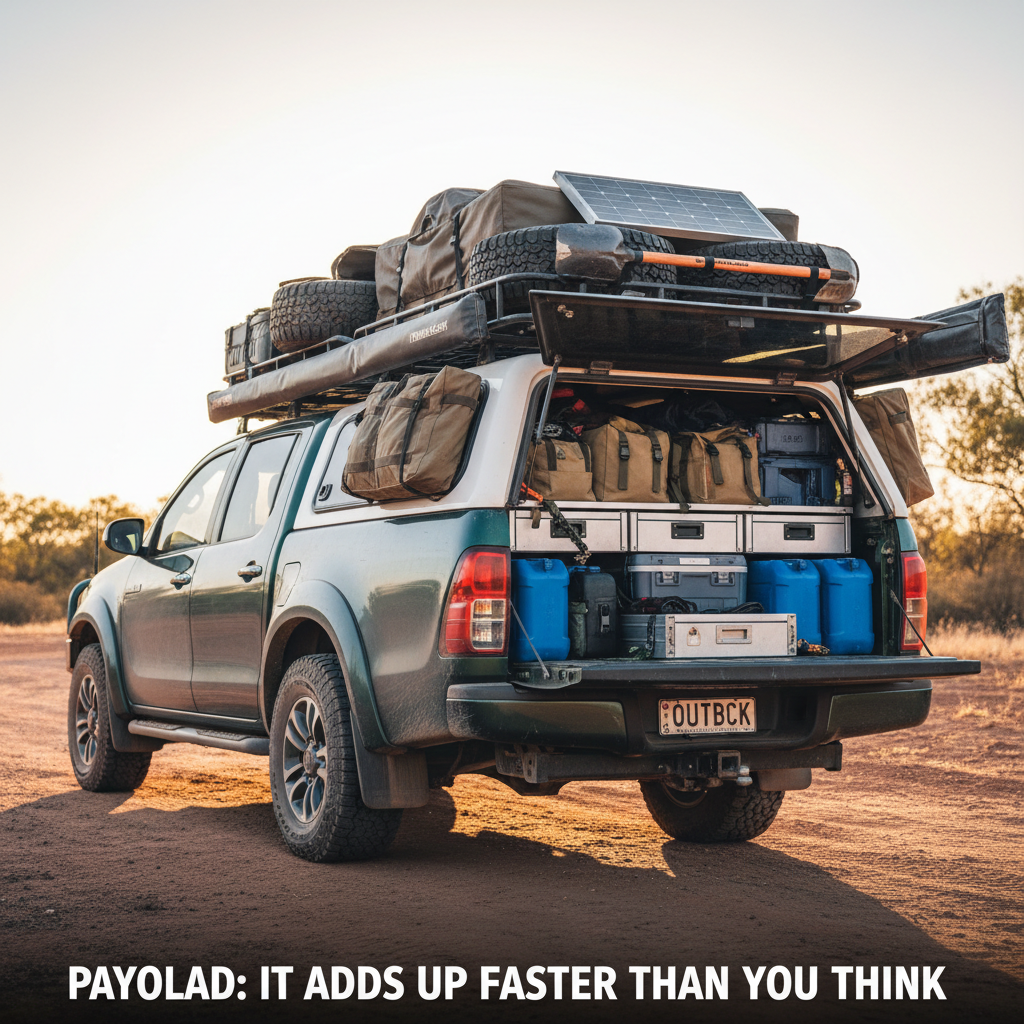
Buyers typically check the tow rating, buy the vehicle, fit a bullbar, add a canopy, install drawers, put on a roof rack, add recovery gear, install a dual battery, go on their first trip with four passengers, then hitch the caravan. At no point in this sequence did anyone sit down and run the full payload tally. The vehicle may have been at or over its GVM before the caravan was even attached.
This isn't a story about reckless owners. It's a story about a process that encourages sequential decision-making rather than holistic weight planning. The dealership, the accessory shop, and the caravan dealer each see one piece of the puzzle. Nobody is holding the full picture.
---
SUV vs Dual Cab Payload Realities
The dual cab vs SUV discussion is common in the towing world, and payload is often cited as a point of difference. The reality is more nuanced.
Dual cab utes commonly have published payload ratings of 850–1,050kg depending on variant and specification. However, a heavily accessorised dual cab with a canopy, bullbar, winch and roof system may have an effective remaining payload of 500–600kg before passengers and cargo.
SUVs often have published payloads of 600–850kg, but their tare weights are frequently lower than equivalent dual cabs, and their accessory footprints are often smaller. An SUV owner carrying two passengers and a light accessory load may have more practical payload headroom than a dual cab owner with a full touring fit-out.
The more useful question than "which vehicle type has more payload" is: what will my actual setup weigh, and what will be left over for passengers and gear?
---
Common Mistakes Buyers Make
**Comparing published payload to total load in isolation.** Buyers calculate accessories + passengers + gear and conclude they're within payload. But they haven't included tow ball mass, or they've underestimated accessory weights.
**Not accounting for progressive load growth.** The vehicle that's compliant when first purchased may not be compliant two years later after successive accessory additions.
**Using tare weight from a variant they didn't buy.** A base model and a high-spec variant of the same vehicle can differ by 100–150kg in tare weight.
**Forgetting fuel in auxiliary tanks.** Diesel weighs approximately 0.85kg per litre. A 130-litre long-range tank, when full, adds around 110kg to payload.
**Treating payload as a rough guide rather than a hard limit.** GVM is a legal limit, not a suggestion. Exceeding it creates insurance, safety, and potential regulatory exposure.
---
Why Weighbridge Checks Matter
The only way to know your actual vehicle weight is to weigh it. Public weighbridges are accessible across Australia, typically at truck stops, waste facilities, and agricultural sites. Costs are usually modest. The process for a basic vehicle weight check takes around 15 minutes.
A weighbridge visit is particularly worthwhile when you've recently fitted a significant number of accessories, before a long touring trip, or when towing a caravan for the first time in your current configuration.
The weighbridge will confirm your actual GVM position and give you individual front and rear axle readings — which matters because a vehicle can be within GVM but still have an axle rating exceeded.
---
Practical Setup Planning Tips
**Step 1: Establish your real baseline payload.** Get your vehicle's GVM and actual tare weight. Calculate the difference.
**Step 2: List every accessory you plan to fit, with actual weights.** Use manufacturer weights where available.
**Step 3: Estimate passenger weight honestly.** Use 80kg per adult, 35–40kg per child as a starting point.
**Step 4: Include actual loaded coupling download.** Obtain the measurement for the intended load and hitch condition. Do not infer it from ATM or add it again to an already coupled starting mass.
**Step 5: Add any auxiliary fuel or water.** Multiply litres by their respective weight per litre.
**Step 6: Total all of the above and compare to your baseline payload.** If the number is negative, you have a problem to solve before purchase, not after.
**Step 7: Visit a weighbridge once fitted out.** Use the actual number to confirm your calculations.
---
Conclusion and Next Steps
Payload is the constraint that binds everything else together in a touring setup. A generous tow rating means nothing if the vehicle is already at GVM before the caravan is hitched.
The good news is that payload management is straightforward when you approach it as a complete system rather than a series of independent decisions. Running the numbers before purchasing accessories — or before buying the vehicle itself — is far easier than trying to unwind a non-compliant setup afterwards.
If you'd like a structured review of your vehicle setup, planned accessories and towing combination — including an independent payload assessment and identification of any weight-related risks — our advisory service can work through the specifics with you.
---