How to read weight figures and examples
- Ratings are maximum limits, not measurements of your loaded setup. Confirm the exact variant and approved ratings.
- Measure loaded coupling weight. A percentage or the difference between ATM and GTM ratings does not establish today's coupling weight.
- An added load changes both axle reactions according to its position. A change is not a total axle load; use measured starting axle weights and add each load once.
- Combination mass is unhitched loaded vehicle plus total loaded trailer, or the sum of all coupled axle readings. Count coupling mass once.
- Examples and AI suggestions are planning aids, not verified measurements or compliance clearance. Unknown figures require measurement; active weight-distribution hitches and gooseneck arrangements need their own assessment.
Introduction
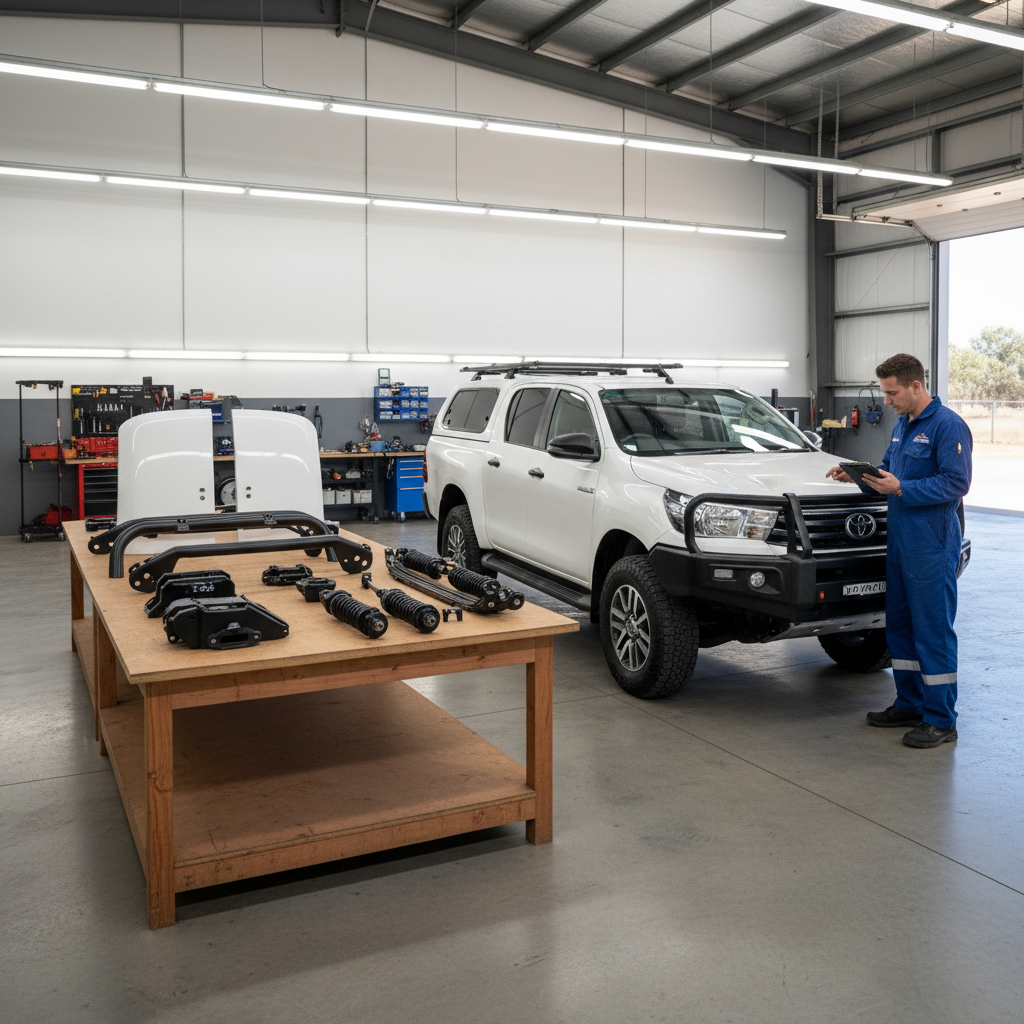
Modifying a vehicle for touring, towing or off-road use is a process that almost always unfolds incrementally. A bullbar here, a set of drawers there, a canopy when the budget allows, and a GVM upgrade when the rear starts sagging. Each decision seems reasonable in isolation. The problem is that they're rarely evaluated together — and by the time the full setup is in place, the weight position may already be non-compliant.
The solution isn't complicated: plan the complete setup before starting. Understand what the vehicle can carry, what each modification will cost in terms of payload, and where the limits are that you can't exceed. This article walks through how to do that planning effectively.
---
Why Planning Before Modifications Matters
There's a predictable pattern in how modification-related issues develop. A vehicle is purchased. Accessories are added over time — each one feels like a sensible addition. Nobody adds them all up. A few years later, the owner visits a weighbridge for the first time and discovers the vehicle is well over its GVM, with no straightforward way to get back under.
Undoing a build is expensive. Selling a heavy steel canopy, recovering what you paid for a bullbar, or absorbing the cost of switching from steel to alloy accessories — these are real costs that could have been avoided with a weight plan before the first accessory was purchased.
Planning ahead also allows you to make smarter trade-offs. Knowing the weight budget in advance lets you choose alloy over steel, lithium over AGM, or eliminate a non-essential accessory — saving payload where it matters, before the money is spent.
The planning cost is a few hours and some research. The cost of not planning can run to thousands of dollars.
---
Understanding Your Intended Vehicle Use
Before planning any modifications, the starting question is: what is this vehicle actually going to do?
The answer shapes every subsequent decision. A vehicle used primarily for daily driving and occasional light camping has very different modification needs from a vehicle that will spend three months a year towing a 2,800kg caravan through remote Queensland.
Common use categories and their implications:
**Daily driver with occasional touring:** Payload requirements are moderate. A lighter build preserving more payload for gear and passengers is often the right approach.
**Family caravan towing:** Tow ball mass, rear axle load and total payload are the binding constraints. The modification build needs to leave enough headroom for the caravan's tow ball mass after accounting for all accessories and passengers.
**Remote 4WD touring:** Ground clearance, recovery capability and fuel range matter. These come with weight costs — long-range tanks, recovery gear, skid plates — that all consume payload.
**Work vehicle with occasional recreation:** GVM and payload capacity are critical. Heavy canopy builds and large tool loads are common. Modifications need to be planned with the full working load in mind.
---
Touring vs Towing vs Daily Driving Considerations
The weight implications of each use type differ enough to affect how you plan your build.
**Touring without towing** puts all the load into the vehicle — passengers, fuel, water, camping equipment and accessories. The GVM is the only limit that matters (along with axle ratings). Builds can focus on storage efficiency and reducing tare weight to preserve payload.
**Towing adds a second weight dimension.** Tow ball mass from the trailer counts against vehicle payload. GCM (Gross Combination Mass) — the combined weight of vehicle and trailer — adds a second limit that must be respected alongside GVM.
**Daily driving** means the vehicle is regularly used at lower loads, but modifications fitted for weekend use travel with the vehicle all week. A 150kg bullbar fitted for off-road touring is adding to fuel consumption, front axle load and tare weight every day, regardless of whether you're off-road or commuting.
---
Payload Planning Before Adding Accessories
The foundational step in any modification plan is establishing your actual available payload.
**Step 1: Get your vehicle's GVM and actual tare weight.** The tare weight in the brochure is often the lowest possible figure for the vehicle line. Your specific variant, with its factory options, may be heavier.
**Step 2: Calculate baseline payload.** Payload = GVM − Tare weight. This is your total budget.
**Step 3: Subtract fixed passengers.** Who will be in the vehicle on a typical trip? Two adults is 160kg. A family of four might be 260–280kg. This is payload consumed before any gear or accessories.
**Step 4: Subtract planned accessories.** List every modification you intend to make. Find the weight of each. Use actual manufacturer weights rather than estimates.
**Step 5: Include measured loaded coupling download if towing.** A trailer ATM rating cannot establish that load. Do not add it again if your starting vehicle weight was already measured coupled.
**Step 6: Total the above and compare to baseline payload.** If the total exceeds your payload, you have a planning problem to solve — either by choosing lighter accessories, reducing the accessory count, or considering a higher-GVM vehicle.
---
Common Accessory Weight Impacts
**Important:** Accessory weights vary significantly by brand, material and fitment. Manufacturer-published product weights may not include mounting hardware, brackets, wiring and other fitment components. For compliance-critical payload planning, obtain actual fitted weights from your installer or from a weighbridge check. Do not treat indicative ranges as precise figures.
Bullbar
Steel bullbars typically weigh 45–80kg fitted, depending on brand, format and vehicle. Alloy alternatives are typically 25–45kg. The choice between steel and alloy sets the tone for how much payload remains for everything else. Front-mounted weight also affects front axle load independently of overall GVM. Confirm actual product weight from the manufacturer's specification sheet before planning your payload budget.
Winch
Electric winches for mid-size 4WDs typically weigh 18–40kg including mounting hardware, rope and fairlead. This weight is mounted at or behind the bullbar, concentrating load on the front axle. A winch is a meaningful weight investment — it's worth ensuring it's genuinely needed for your intended use.
Canopy
A full steel canopy over a dual cab tray typically weighs 100–180kg fitted. An aluminium canopy is typically 60–110kg. This is one of the largest single modifications by weight, and it sits predominantly over the rear axle. For towing setups, this rear-loaded weight combines with tow ball mass to create significant rear axle load. Always use the manufacturer's actual published weight for your specific canopy and vehicle fitment — generic estimates frequently understate actual fitted weight.
Roof Rack
A roof rack or platform typically adds 18–40kg. Once accessories are mounted — awning (10–18kg), solar panels (14–22kg each), rooftop tent (40–75kg) — the roof load accumulates quickly and also raises the vehicle's centre of gravity.
Drawers
A full-width drawer system typically weighs 35–75kg in structure alone, depending on construction and material. The contents — tools, recovery gear, camp kitchen, spare parts — add further weight. Drawers mounted in the rear of a canopy sit over or behind the rear axle, contributing directly to rear axle loading.
Larger Tyres
Upgrading from stock to larger all-terrain options adds weight at each corner. A stock tyre might weigh 12–14kg; a larger all-terrain option might be 18–24kg. With four tyres plus a spare, a tyre upgrade can add 30–50kg.
Long-Range Fuel Tank
A replacement or additional long-range tank can hold 80–200 litres depending on configuration. Diesel weighs approximately 0.85kg per litre. A 150-litre tank, when full, adds around 128kg of payload-consuming weight — at its heaviest when the vehicle is setting off on a long trip.
---
Front and Rear Axle Considerations
Vehicle weight is not distributed equally between axles, and each axle has its own rating that must be respected independently of overall GVM.
**Front axle loading** is most affected by front-mounted accessories (bullbar, winch, dual battery in the engine bay), driver and front passenger weight, and fuel in the main tank.
**Rear axle loading** is most affected by rear-mounted accessories (canopy, drawers, long-range tank, tow bar), tow ball mass acting behind the rear axle, increasing rear load and unloading the front, rear passengers, and cargo loaded in the tray or rear of the cabin.
The concern most commonly seen in modified touring setups is **rear axle overload** — where the combination of canopy, drawers, full auxiliary tank and tow ball mass pushes the rear axle beyond its rated limit, even when the overall GVM appears to have headroom.
When planning modifications, calculate the approximate axle load separately from overall GVM. If rear axle load appears tight, consider front-loading some weight, choosing a lighter canopy material, or reducing the size of the rear fuel tank.
---
Suspension Planning Considerations
Factory suspension is designed for a specific load range. When accessories significantly increase the static load on the vehicle — particularly at the rear — the suspension may operate near or at the bottom of its travel under normal touring conditions. This results in reduced suspension travel for absorbing bumps, harder ride when loaded, and risk of bottoming out on rough terrain.
Suspension upgrades — heavier-duty springs, airbag assists, or full aftermarket setups — can address this. However, suspension modifications interact with other ratings in ways worth understanding:
If your planned build is likely to significantly load the rear, planning for appropriate suspension early avoids having to undo and redo work later.
---
Towing and Towball Weight Planning
If your vehicle will tow, the towing configuration needs to be part of the modification plan from the start, not added as an afterthought.
**Tow ball mass from the trailer counts against vehicle payload.** A caravan with a 2,500kg ATM will typically have a tow ball mass of 250–300kg. This weight is carried by the vehicle and counts against GVM.
**Tow bar height matters.** After a suspension lift or spring upgrade, the tow ball height may no longer match the caravan coupling. If the heights are mismatched by more than 50–75mm, the caravan may not tow level, affecting weight distribution and handling.
**GCM is a separate limit.** If your vehicle has a published GCM, the combined weight of the loaded vehicle and loaded trailer cannot exceed it. This limit is separate from and in addition to GVM and tow rating.
**Tow rating and payload interact.** Your vehicle might be rated to tow 3,500kg, but if your payload is fully consumed by accessories and passengers, there may be no capacity left for the tow ball mass — making the rated tow capacity effectively unreachable with your setup.
---
Why Modifications Interact With Each Other
Modifications don't exist independently — they interact in ways that can create problems even when each individual modification seems reasonable.
**Bullbar + winch → front axle load.** Each is manageable alone. Combined, they concentrate substantial weight on the front axle. If a dual battery is also front-mounted, the front axle load concern becomes more significant.
**Canopy + drawers + long-range tank → rear axle load.** Three rear-weighted modifications combine to create a rear axle load that may exceed the rating even before tow ball mass is added.
**Lift kit + canopy → tow ball height.** A lift raises the rear of the vehicle. A heavy canopy depresses it. The interaction determines whether the tow ball height is appropriate for level towing.
**Larger tyres + GVM → braking performance.** Larger tyres change the effective gear ratio and increase unsprung mass. At rated GVM, braking distances may extend beyond what the manufacturer tested for.
**GVM upgrade + GCM.** Many standard GVM upgrades increase how much the vehicle can carry but do not change the GCM. If GCM was the limiting factor before the upgrade, it may remain so after — unless the specific upgrade package explicitly includes a GCM increase. Always verify this against your upgrade approval documentation.
---
Why Weighbridge Awareness Matters
A modification plan built on paper is a starting point. A weighbridge visit with the completed setup is the confirmation.
Public weighbridges are available across Australia at truck stops, waste transfer facilities, and agricultural sites. Costs are typically modest, and a full vehicle weight check takes around 15 minutes.
What a weighbridge tells you:
The weighbridge visit is particularly valuable because it catches the gap between theoretical and actual. Accessory weights may be higher than published figures. Load distribution may not match what was assumed. If the weighbridge result shows a problem, addressing it early is significantly easier than addressing it after the fact.
---
Common Mistakes Owners Make
**Starting modifications without establishing baseline payload.** If you don't know your payload budget, you can't track how quickly you're consuming it.
**Using brochure tare weights rather than actual delivered weights.** Higher-spec variants are often 100–150kg heavier than the base model brochure figure. Starting from the wrong baseline payload leads to incorrect conclusions.
**Not including passengers in the calculation.** Forgetting passengers, or using a placeholder of one adult rather than the actual number of occupants, leads to underestimating real load.
**Adding accessories over time without tracking cumulative weight.** The vehicle that was compliant after the first two accessories may not be compliant after the fifth. Each addition should be evaluated against the remaining payload, not in isolation.
**Underestimating fluid weights.** A 130-litre long-range tank full of diesel weighs approximately 110kg. A 60-litre water tank weighs 60kg. These weights are consistently underestimated — particularly because the vehicle sets off on a long trip with tanks full.
**Leaving tow ball mass out of the payload calculation.** This is the most consequential omission for towing setups. Tow ball mass is payload, and it can represent 250–350kg for a heavy van.
---
Planning for Future Upgrades
A modification plan should account for not just the first set of changes, but where the build is likely to go over time.
If you're starting with a bullbar and drawers now but plan to add a canopy and a GVM upgrade in 18 months, build that into the plan from the start. The GVM upgrade pathway for your intended vehicle matters — not all vehicles have approved upgrade kits available, and pre-registration upgrades typically allow higher upgrade thresholds.
Thinking about the completed build rather than just the next step means you can choose materials and specifications now that will work within the final setup, you won't need to sell and replace accessories that don't fit the completed picture, and you understand where the compliance limits are before you reach them.
---
Touring and Load-Carrying Considerations
**Fuel range:** A larger fuel tank extends range but adds weight when full. A 150-litre long-range setup carries around 128kg of fuel weight at full capacity. Is that range genuinely needed for the planned touring destinations, or could a smaller auxiliary tank achieve the same practical outcome?
**Water carrying:** Water weighs 1kg per litre. Carrying 100 litres is 100kg of payload. If most touring destinations have water access, carrying full tanks from the start may be unnecessary weight.
**Gear discipline:** Every kilogram of camping or recovery gear carried is a kilogram of payload consumed. Touring setups that are never audited tend to accumulate gear over time. A periodic audit of what's actually carried and what's just stored permanently in the vehicle is worth doing in the context of the overall payload position.
---
Practical Setup Planning Tips
**1. Build a weight spreadsheet before spending money.** List the vehicle's GVM, tare weight, and payload. Add rows for every planned modification with actual weights. Add passengers and intended load. Add tow ball mass if towing. Track the running total against payload.
**2. Use actual manufacturer weights, not estimates.** For heavy items like canopies and bullbars, manufacturers publish weights — use those, not generic estimates. Be aware that published product weights may not include mounting hardware, brackets and wiring. If you cannot confirm the actual fitted weight, use conservative upper-range estimates and treat any payload figure as approximate. A weighbridge check with the vehicle at touring load is the only way to verify your actual position.
**3. Plan in stages, but evaluate the complete picture.** Doing the build in two or three stages is fine. But make sure the final completed build fits within payload before committing to the overall direction.
**4. Consider material choices as a system.** Steel vs alloy across bullbar, canopy, and drawers can represent a 150–200kg difference in total accessory weight.
**5. Account for fluids at maximum capacity.** When evaluating payload, use full fuel and water weights rather than average or typical levels. The heaviest touring load is the relevant test.
**6. Weigh the vehicle after each major modification stage.** Don't wait until the full build is complete. Weighing after the canopy and drawers are fitted gives you actual data to refine the rest of the planning.
**7. If towing, plan the towing configuration from the start.** Tow ball height, GCM, and the interaction between tow ball mass and rear axle load all need to be part of the initial setup plan, not retrofitted considerations.
---
Conclusion and Next Steps
Vehicle setup planning is straightforward when it's done proactively — and complicated, expensive, and frustrating when it's done reactively after the build is in place.
The most common observation in advisory situations is that owners who encounter weight problems could have avoided them entirely with a few hours of planning before the first modification was purchased. The information needed is accessible: GVM, tare weight, accessory weights, and a basic calculation. The problem is that this calculation is rarely prompted by the people selling the accessories.
If you'd like to have your planned or existing vehicle setup reviewed — including a payload assessment, accessory weight evaluation, and identification of any areas where the build may be creating weight-related risks — our advisory service can work through the specifics with you.
Start a Risk Scan to get a structured assessment of your current or planned setup.
---