How to read weight figures and examples
- Ratings are maximum limits, not measurements of your loaded setup. Confirm the exact variant and approved ratings.
- Measure loaded coupling weight. A percentage or the difference between ATM and GTM ratings does not establish today's coupling weight.
- An added load changes both axle reactions according to its position. A change is not a total axle load; use measured starting axle weights and add each load once.
- Combination mass is unhitched loaded vehicle plus total loaded trailer, or the sum of all coupled axle readings. Count coupling mass once.
- Examples and AI suggestions are planning aids, not verified measurements or compliance clearance. Unknown figures require measurement; active weight-distribution hitches and gooseneck arrangements need their own assessment.
Introduction
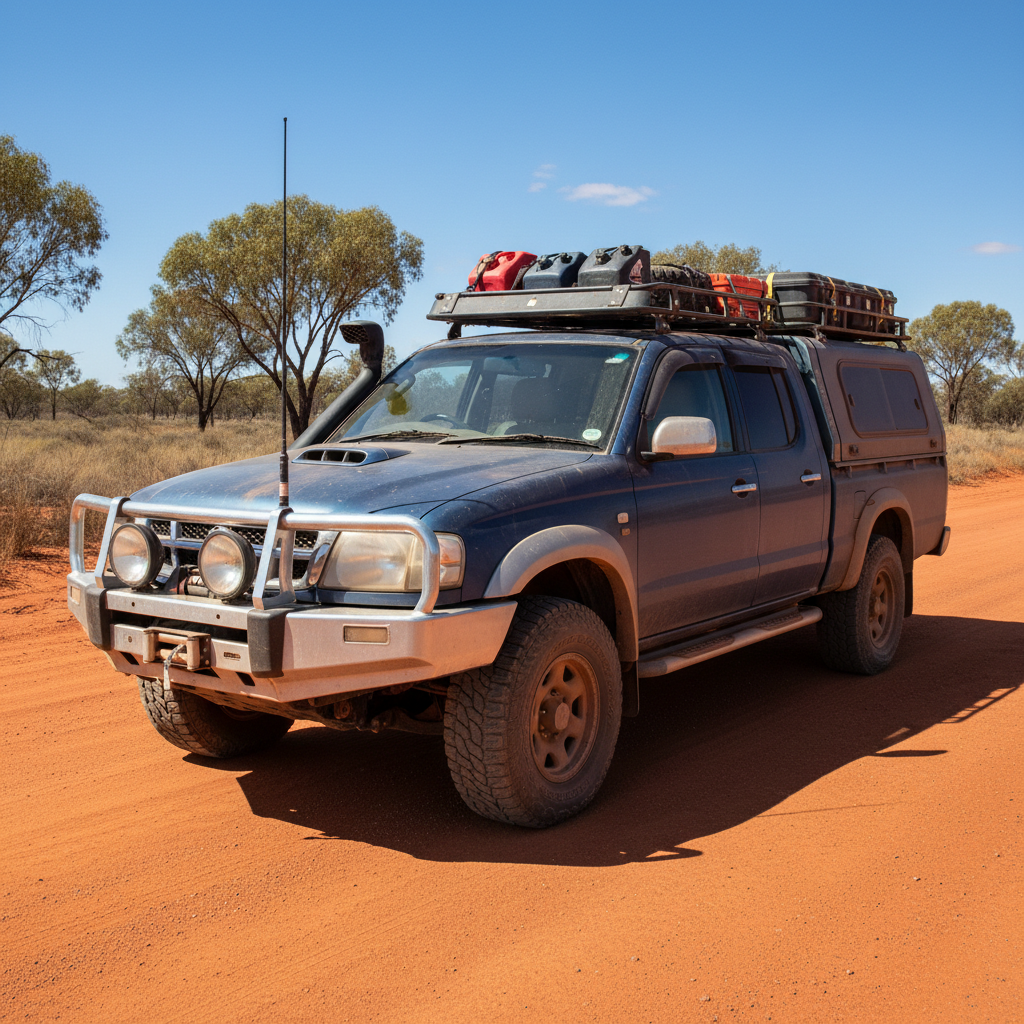
One of the most common ways Australian touring vehicle owners end up outside their legal weight limits is through accessories. A bullbar, canopy, drawer system, roof rack or towbar adds weight to the vehicle. These additions are often fitted without any check of whether the vehicle still has payload to spare.
This guide explains how accessories reduce payload, which accessories are the heaviest, and how to check whether your vehicle can accommodate the accessory build you're planning.
---
Why Accessories Reduce Payload
Payload is the weight you can add to the vehicle before reaching GVM. Every accessory fitted to the vehicle is part of that addition — it counts against payload exactly the same way as passengers, fuel, cargo and tow ball mass.
The formula remains:
**Remaining GVM capacity = GVM rating − actual vehicle mass**. Published payload depends on the manufacturer's defined starting mass; tare and kerb are not interchangeable.
But the payload you have left for passengers, cargo and towing is:
Available payload = Payload − Accessories − Fuel and water − Passengers − Cargo − Tow ball mass
If accessories consume 150kg of payload, that is 150kg you cannot use for anything else.
---
Typical Accessory Weights
The following are typical weight ranges for common Australian touring accessories. These are illustrative ranges — actual weights vary by manufacturer, model and configuration. Always check the manufacturer's published weight for your specific product.
| Accessory | Typical Weight (kg) |
|---|---|
| ARB Summit Bullbar | 22–28 |
| Ironman 4x4 Drawer System | 30–45 |
| Canopy / truck top | 25–40 |
| Roof rack (empty) | 8–15 |
| Roof rack (loaded with gear) | 20–60 |
| Dual battery system | 15–25 |
| Lithium battery upgrade | 5–12 |
| Fridge slide / fridge | 15–30 |
| Towbar and coupling | 5–10 |
| Recovery gear (loaded) | 20–40 |
| Side steps | 8–15 |
Illustrative Example
A Toyota LandCruiser 300 GXL with 935kg of payload, fitted with:
| Accessory | Weight (kg) |
|---|---|
| ARB Summit Bullbar | 25 |
| Ironman Drawer System | 35 |
| Canopy | 30 |
| Roof rack (loaded) | 30 |
| Dual battery | 20 |
| Towbar | 8 |
| **Total accessories** | **148** |
Remaining payload after accessories: 935 - 148 = 787kg. That still sounds like a lot — but now add passengers (180kg), fuel and water tanks (90kg), cargo and gear (50kg) and tow ball mass (240kg). Total additional: 560kg. Remaining payload: 787 - 560 = 227kg. The accessories are the second-heaviest addition after tow ball mass.
> **Safety caveat:** Accessory weights vary by manufacturer, model and configuration. The figures above are illustrative ranges. Always check the published weight for your specific product, and if possible, weigh your vehicle at a certified weighbridge after fitting accessories.
---
How Accessories Affect Axle Load Distribution
Accessories do not just reduce payload — they also affect axle load distribution. Your vehicle has separate front and rear axle load ratings, and these operate independently of GVM.
**Front axle:** Bullbars, winches and dual battery systems sit at the front of the vehicle and load the front axle. A heavy bullbar can put the front axle outside its rating even when the vehicle is within GVM.
**Rear axle:** Tow ball mass loads the rear axle directly. Canopies and roof racks toward the rear of the vehicle also load the rear axle.
Illustrative Example
A vehicle with a front axle rating of 1,860kg and a rear axle rating of 1,860kg. Loaded weight with accessories and tow ball mass:
Even though the vehicle is within GVM, the rear axle is outside its rating. This is a compliance issue — axle load ratings are enforced independently of GVM.
Use Tow Match for specification checks; collect actual coupled axle weights or use the detailed geometry calculator for axle loading.
---
Which Accessories Are the Heaviest
Not all accessories are equal. In order of typical impact on payload:
1. **Drawer systems** — the heaviest single accessory (30–45kg)
2. **Canopies** — significant weight (25–40kg), also loads the rear axle
3. **Loaded roof racks** — variable but can be very heavy (20–60kg)
4. **Bullbars** — moderate weight (22–28kg) but concentrated on the front axle
5. **Dual battery systems** — moderate weight (15–25kg), front axle
When payload is tight, the question is not "can I fit this accessory?" but "which combination of accessories gives me the best functionality while preserving payload and axle headroom?"
---
How to Check Whether Your Vehicle Can Accommodate Accessories
1. **Find your GVM and kerb weight** on the compliance plate.
2. **Calculate payload** (GVM minus kerb weight).
3. **List every accessory** you plan to fit, with its published weight.
4. **Add passengers, fuel, water and cargo** you expect to carry.
5. **Include measured loaded coupling download** if it is absent from the vehicle starting mass.
6. **Check whether the total is within payload.**
Use our free Vehicle Checker to do this calculation automatically. The tool has manufacturer specifications for many popular Australian tow vehicles and accessory weight estimates for common products.
---
Planning Accessory Builds Before Purchase
If you are buying a vehicle, plan the accessory build before purchase — not after. This is the single most effective way to avoid payload and axle load problems:
Our Compare Vehicles tool lets you compare payload, axle load and accessory weight across multiple vehicles before you buy.
---
Sources and Review Method
The accessory weight figures in this guide are drawn from:
ClearPath does not verify individual accessory weights. Accessory weights vary by model and configuration. Always check the published weight for your specific product and confirm at a weighbridge where compliance matters.
---
What Next
---